
ETLA Economic Research forecasts 1 percent GDP growth for Finland this year and 1.5 percent growth for next year. Household purchasing power is growing, and consumption is expected to recover slowly this year. The unemployment rate already paints too bleak a picture of Finland’s economic outlook. Inflation will accelerate to nearly 2 percent this year. Achieving the deficit target under the “debt brake” also requires continued fiscal adjustment in Finland. A key risk to the forecast is the state of war in the Persian Gulf, which is not yet destroying growth but could freeze it if prolonged.
Etla’s forecast in summary:
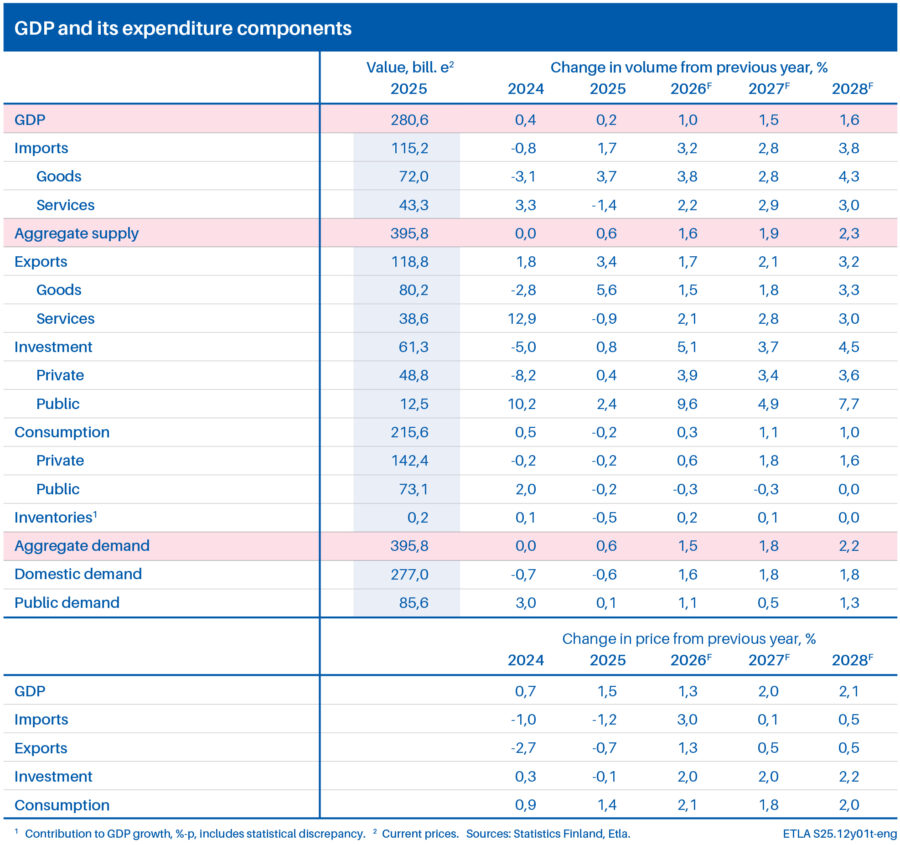
The Finnish economy shifted to modest growth at the turn of the year 2025–2026 and is expected to continue to grow this year as well. Etla forecasts that gross domestic product will grow by 1 percent this year and 1.5 percent next year. In 2028, growth will reach 1.6 percent.
Net exports were the main driver of growth last year, but this year the role will shift as imports begin to grow faster than exports. Now, the main drivers of growth are investments and private consumption.
However, the budding economic growth is threatened by the state of war in the Persian Gulf. Uncertainty in Etla’s forecast is therefore high, particularly regarding the development of global market prices and the cost of sea and air transport.
– “The greatest impact of the conflict in the Persian Gulf has been seen in the prices of oil and oil products, such as transportation fuels. The closure of the Strait of Hormuz has also raised fertilizer prices, which in turn will affect food prices. However, as things stand, the situation is not comparable to the effects of the war in Ukraine in 2022. At that time, global markets for grains and oilseeds were greatly affected by disruptions in Black Sea shipments, which is not the case now. In addition, the disruption in natural gas supply hit Europe when pipeline shipments from Russia were blocked. Now this disruption is more global”, notes Etla Senior Researcher Ville Kaitila.
The war in Iran is slowing global economic growth. The effects are most evident in Asia and the eurozone, but due to the war, Etla has also slightly lowered its growth forecast for the United States. International trade continues to be affected by the trade war as the United States seeks ways to replace the tariffs that the country’s Supreme Court overturned.

Etla’s forecasting team, Senior researcher Ville Kaitila and Senior Researcher Sakari Lähdemäki, are reminding that the key risk to the forecast is the state of war in the Persian Gulf, which is not yet destroying growth but could freeze it if prolonged.
Etla estimates that private consumption in Finland will grow by only 0.6 percent this year. Uncertainty is high, and rising energy prices are weighing on the outlook. Purchasing power is growing slightly faster than consumption. Next year, private consumption could reach just under 2 percent growth, provided that turbulence in the global economy subsides.
Inflation hit zero at the turn of the year for the first time in a long while. The situation in the Middle East is now driving up energy prices, which is why inflation will accelerate to 1.8 percent this year. Inflation is forecast to be 1.5 percent next year and 2 percent in 2028.
EU-harmonized inflation is 2.3 percent this year.
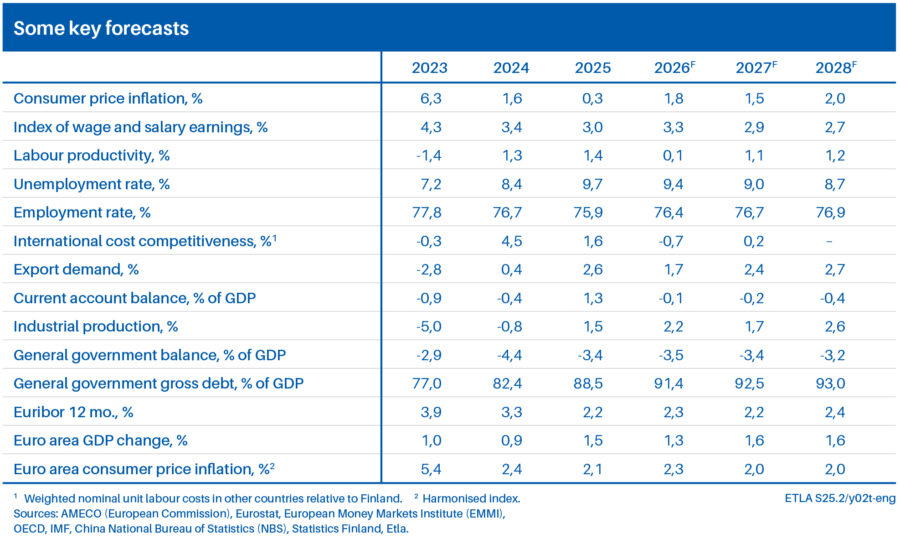
The labour market situation has been sluggish, but this year Etla forecasts that employment will grow by slightly more than half a percent and continue to grow in 2027 as well. The unemployment rate was quite high last year, at 9.7 percent. This is largely explained by the fact that immigration significantly increased the labour force.
According to Etla’s forecast, unemployment will begin to decline slowly this year but will nevertheless remain at a relatively high level in 2027–2028 as well.
However, the official unemployment rate currently paints too bleak a picture of the labor market and the overall state of the economy, emphasizes Etla Senior Researcher Sakari Lähdemäki.
– “A much more moderate picture of the labour market emerges when examining other measures of unemployment, such as the number of unemployed job seekers registered with employment services or the number of people receiving unemployment benefits. Although unemployment has risen according to these indicators as well, the official unemployment rate paints too bleak a picture of the labour market because, according to it, the number of unemployed has grown much more than employment has declined”, emphasizes Etla’s Lähdemäki.
Investments turned to growth last year, and Etla forecasts that growth will continue at around 5 percent this year as well. Public investments are growing, particularly due to fighter jet purchases, while private investments are growing at a slightly more moderate pace. Public investments are also being boosted by additional R&D spending.
The Finnish economy grew last year despite the austerity measures. Without the tariffs imposed by the United States and domestic austerity, economic growth would have been around 1 percent, which is reasonable growth for Finland considering recent history.
In practice, this means an economic upturn, which is precisely when austerity measures should be timed, notes Etla’s CEO Aki Kangasharju.
– “Based on criticism and news headlines, one might have gotten the impression that austerity in Finland has been excessive given the economic cycle. There has been fearmongering about a negative economic spiral, but the fear has been unfounded. The outlook for public finances is so bleak that fiscal adjustment cannot be limited to periods of rapid growth. Rather, the pace of adjustment needs to be stepped up”, says Kangasharju.
So far, according to Etla’s estimates, the adjustment has not been particularly strong, nor has it prevented the economy from returning to growth in 2025. However, rising health and social services, defence, and interest expenses are shifting the burden of the adjustment to other areas of public finances, which may heighten the perception of the magnitude of the adjustment measures.
The general government deficit decreased by one percentage point relative to gross domestic product last year. Part of this reduction was due to active fiscal adjustment, and part was due to the deficit shrinking naturally as a result of modest economic growth. Debt was brought under control largely through increased tax and other revenues rather than reduced spending.
– “Even achieving the deficit target under the “debt brake” will require future governments to continue with austerity measures. In the long run, the focus of fiscal adjustment must shift toward reducing expenditures”, Kangasharju notes.

“The outlook for public finances is so bleak that fiscal adjustment cannot be limited to periods of rapid growth. Rather, the pace of adjustment needs to be stepped up”, says Aki Kangasharju, CEO of ETLA.
The online version of the Spring 2026 Economic Outlook (in Finnish) will be available on Wednesday, March 25, at suhdanne.fi. All figures and tables from the online version can also be downloaded separately from the website.